
This deep dive expands on the streaming payment concepts from "Money that rules." It covers how covenants and CashScript make continuous payments possible on BCH — without a payment processor. This is technical content for developers and the deeply curious.
Most payments are discrete events: you buy a coffee, you send an invoice, you pay rent once a month. But money often behaves more like a flow. Salaries accrue. Rent is owed continuously. A subscription gives access for a period. A vesting schedule releases tokens over years.
On a traditional payment rail, those flows are approximated with charges and invoices. On BCH, a contract can represent the flow directly.
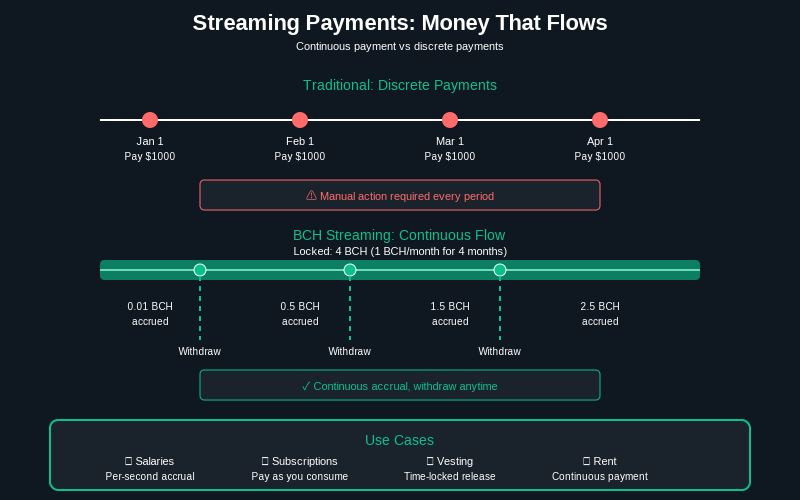
Lock the money, release it over time
The basic pattern is a contract that holds a balance and lets the recipient withdraw the portion that has accrued so far. The contract checks the current time or block height, allows a withdrawal up to that amount, and requires the remainder to return to the contract. The next withdrawal repeats the calculation.
That is a streaming payment. It is not a recurring card charge. It is a continuous claim on a locked balance. The recipient can withdraw when they want, and the sender does not need to be online for every payment. The contract enforces the schedule.
CashScript's covenant support makes this practical. The contract can inspect the outputs of the withdrawal transaction, require the remainder to go back to the same contract lock, and use a timelock to calculate how much has vested. The 2025 BigInt upgrade and the 2026 loops and functions make the math and structure more manageable.
What it can model
- Salaries: pay accrues per second and the employee withdraws when needed.
- Subscriptions: access is paid continuously, with cancellation stopping future accrual.
- Vesting: tokens unlock on a schedule, with the remainder held by the contract.
- Allowances: a parent or employer sets a budget that a child or contractor can draw down over time.
- Rental: a deposit and rent stream are held in one contract, with the deposit returned when the conditions are met.
Automation makes it seamless
A streaming contract releases the accrued balance when a withdrawal is submitted. A wallet background process or a non-custodial service can submit it for the recipient. The service cannot redirect the money; it can only send it to the recipient the contract specifies. If the service is unavailable, the recipient can withdraw manually. The contract remains the source of truth.
That is a good division of labor: the contract enforces the schedule, and a service provides convenience without custody.
What streaming is for
Streaming is a payment tool. It releases money that is already locked on a schedule, so it is a natural fit for salaries, subscriptions, vesting, allowances, and rental deposits. It makes the payment mechanics automatic, transparent, and cheap.
The bigger idea is that money can be conditional in time, not just in amount. Once that is cheap and programmable, a lot of subscription and payroll software starts to look like a thin interface over a contract.
For more on the building blocks, see Covenants: rules that follow the coin and The 2026 upgrade.
We do not provide financial advice.