
BCH contracts give you programmable money with real power. Four key capabilities — loops, functions, bitwise operations, and larger scripts — let you build sophisticated financial logic directly on the blockchain.
What you can build right now
BCH contracts support a complete toolkit for programmable money:
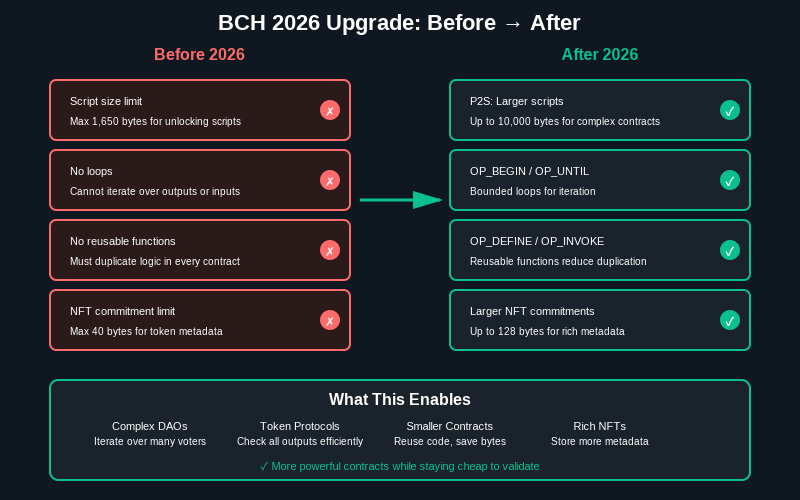
- Pay to Script (P2S): Bare pay-to-script outputs, NFT commitments up to 128 bytes, and unlocking bytecode up to 10,000 bytes. This means simpler, smaller transactions for vaults, multi-party contracts, and token applications.
- Bounded loops:
OP_BEGINandOP_UNTILlet you process lists, repeat calculations, and iterate over outputs. Loops are checked against VM resource limits, so repetitive logic works without unbounded execution. - Functions:
OP_DEFINEandOP_INVOKElet you organize bytecode into reusable functions. No more duplicated blocks — write once, invoke anywhere. - Bitwise operations: Efficient bit-level operations for hashing, flags, and cryptographic logic. No more workarounds or emulation — direct bit manipulation is fast and clean.
How the pieces work together
Loops let you process a list or repeat a calculation. Functions make that logic modular and easier to audit. Bitwise operations make low-level cryptography and compact state practical. P2S gives contracts more room and a cleaner output format. Together they form a complete contract toolkit for money.
The ecosystem includes native tokens, covenants, and introspection. A vault can enforce detailed payout policies. A token protocol can loop over outputs and validate every one. A contract can share bytecode instead of duplicating it. That reduces transaction size and audit surface — critical when real money is locked in the contract.
Practical applications
Developers are building with these primitives today:
- Escrow with restricted payout conditions
- Savings vaults that enforce withdrawal rules
- Inheritance contracts with time-locked access
- Atomic swaps for trustless cross-chain trades
- Streaming payments that release funds over time
- Token sales with automated distribution
- Membership systems with on-chain verification
- Multi-party settlement with shared control
These aren't theoretical. They use the same primitives that power the network: multisig, timelocks, hash locks, introspection, and native tokens.
The toolkit is production-ready
BCH provides everything developers need: a readable contract language (CashScript), native tokens (CashTokens), covenants that enforce rules, loops and functions for complex logic, and larger standard scripts for sophisticated contracts.
The ecosystem includes wallets, SDKs, testing tools, and metadata standards. The base layer stays cheap and simple while the contract layer delivers real power. Developers build on the same chain that settles payments — no new gas token, no new network, no bridging required.
The best applications are being written right now. That's the opportunity.
For the technical foundation, see The script under every wallet, CashScript without the ceremony, and Covenants: rules that follow the coin.
We do not provide financial advice.